

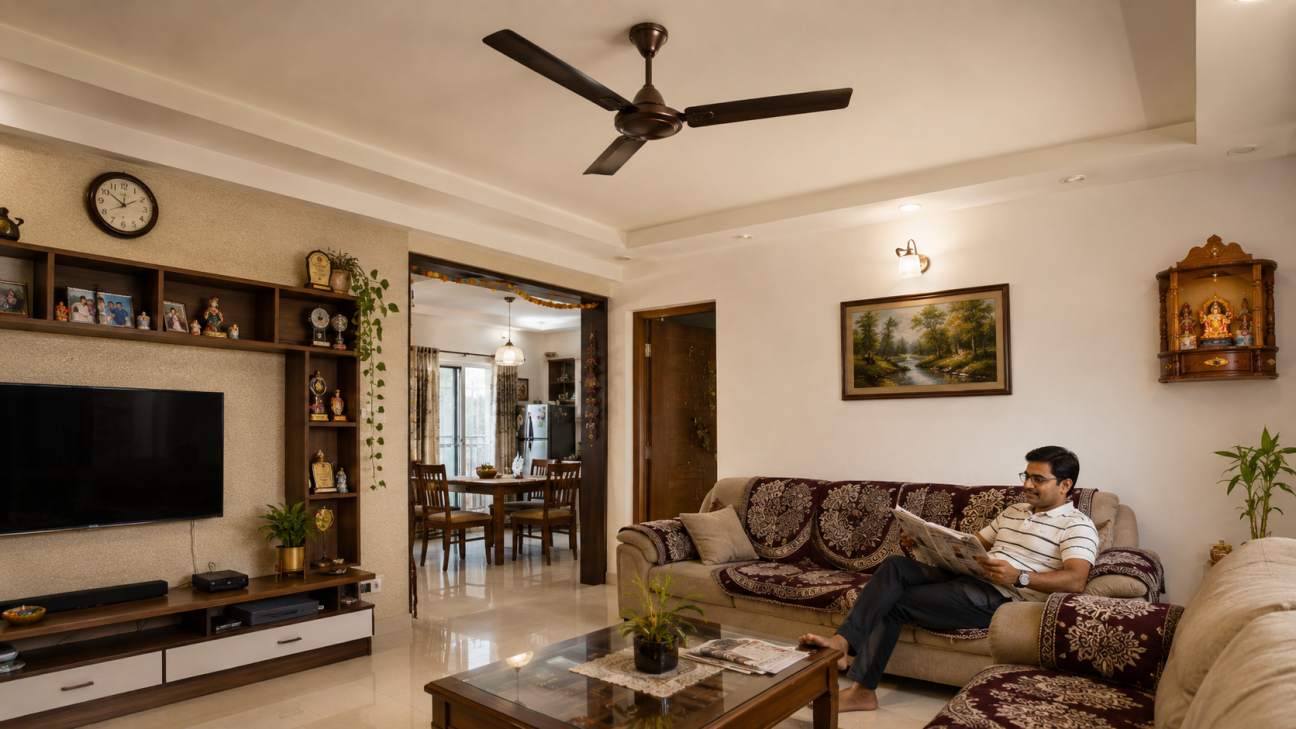
India’s transition toward energy-efficient appliances is entering a new phase as government agencies, DISCOMs, manufacturers, and energy-efficiency partners increasingly focus on accelerating the adoption of BLDC ceiling fans across the country. What was once considered a niche premium category is now rapidly becoming one of the most important demand-side energy efficiency opportunities in India’s residential power ecosystem.
The reason is simple. Ceiling fans remain one of the largest contributors to residential electricity consumption in India. In a tropical climate where fans operate for long hours across homes, offices, retail shops, schools, and institutions, even small improvements in energy efficiency can create a massive national impact on electricity demand. Traditional induction-motor ceiling fans commonly consume between 70W and 85W during operation, while modern BLDC fans can reduce that consumption dramatically, often operating between 28W and 35W while delivering similar airflow performance.
This reduction may appear small at an individual level, but at India’s scale, the cumulative impact is enormous. According to data highlighted by the Ministry of Power and EESL, ceiling fans account for nearly 40% of residential electricity consumption in many Indian households, and replacing inefficient fans with high-efficiency alternatives has the potential to reduce a significant portion of national residential power demand.
As a result, India’s energy-efficiency ecosystem is increasingly prioritizing BLDC fan adoption through policy initiatives, demand-side management programs, utility-backed replacement schemes, and public-private collaborations. The broader objective is not only to reduce electricity bills for consumers but also to lower grid stress, reduce peak demand, and support India’s long-term sustainability and energy transition goals.
Over the past few years, several DISCOMs across India have launched fan replacement schemes under Demand Side Management (DSM) initiatives aimed at encouraging consumers to replace old inefficient ceiling fans with BEE 5-star rated BLDC fans. Utilities are increasingly viewing appliance efficiency as one of the most cost-effective ways to manage future electricity demand without requiring equivalent expansion in power generation infrastructure.
Among the most active regions in this transition has been Delhi, where BSES Rajdhani Power Limited (BRPL) and BSES Yamuna Power Limited (BYPL) have launched major replacement schemes focused on super energy-efficient BLDC fans. Under these programs, domestic consumers are encouraged to exchange conventional fans for BEE 5-star rated BLDC models at heavily discounted prices.
The scale and seriousness of these programs demonstrate how aggressively utilities are now approaching appliance efficiency. In one of the schemes approved under Delhi Electricity Regulatory Commission (DERC) guidelines, BRPL proposed the replacement of tens of thousands of conventional ceiling fans over a multi-year period in order to reduce energy consumption across its licensed distribution area.
The economics behind these programs are becoming increasingly attractive for both consumers and utilities. According to BSES estimates, replacing conventional fans with BLDC fans can help households save approximately ₹1,800 annually per fan under certain usage conditions. While the exact savings vary depending on operating hours and electricity tariffs, the payback period for BLDC fans is steadily decreasing as manufacturing costs decline and large-scale adoption increases.
This is where the role of manufacturers becomes especially important. One of the biggest barriers to BLDC fan adoption in India has historically been higher upfront pricing compared to conventional fans. Although consumers recognize the electricity savings potential, many still hesitate because of the initial purchase cost difference. The next phase of India’s BLDC transition therefore depends heavily on making high-efficiency fans more affordable for mass-market consumers.
Helfinch is among the companies working toward solving this affordability challenge by developing lower-cost, energy-efficient BLDC products designed specifically for large-scale adoption. The company has introduced a 28W BLDC ceiling fan platform aimed at consumers who want to upgrade from traditional 1-star or lower-rated ceiling fans without paying premium pricing associated with high-end smart fan categories.
Retailing at approximately ₹2,199 inclusive of all taxes, Helfinch’s 28W BLDC fan is positioned as an entry-level energy-efficient alternative for households looking to reduce electricity consumption while maintaining affordability. The strategy reflects a larger industry realization that India’s next wave of energy-efficiency growth will come not only from premium consumers but also from large-scale replacement demand among middle-income and value-conscious households.
This mass-market transition is becoming increasingly important because India still has millions of inefficient ceiling fans operating across residential and commercial environments. Many of these fans are older induction-based models consuming significantly more power than modern BLDC alternatives. Replacing even a fraction of this installed base could create substantial electricity savings nationwide.
The Ministry of Power and Bureau of Energy Efficiency (BEE) have been actively supporting this transition through broader energy-efficiency frameworks, appliance labeling programs, and demand-side management initiatives. Under the Energy Efficient Fans Programme (EEFP), the government and EESL have emphasized the need to accelerate deployment of energy-efficient BLDC fans across India.
Government officials have repeatedly highlighted that inefficient fans will gradually be phased out in favor of higher-efficiency alternatives. The long-term direction is increasingly clear: India’s residential cooling ecosystem is expected to move steadily toward 5-star rated, energy-efficient ceiling fans as the default standard rather than the premium exception.
Industry experts believe this transition could become one of the most important appliance replacement cycles in India over the next decade. Unlike many other household appliances, ceiling fans are nearly universal across Indian homes. This creates a uniquely large-scale opportunity for electricity savings, especially as rising temperatures continue increasing fan usage across urban and semi-urban regions.
The involvement of organizations such as GreenTree is also helping accelerate this transformation. GreenTree has emerged as an important facilitator in driving DISCOM-led energy-efficiency initiatives and supporting large-scale BLDC adoption programs across multiple regions. Companies operating in this ecosystem are increasingly acting as implementation partners connecting manufacturers, utilities, financing systems, logistics providers, and consumers.
This integrated approach is critical because appliance replacement programs involve far more than simply selling products. Successful implementation requires coordination across procurement systems, subsidy structures, consumer awareness campaigns, warehousing, logistics, installation support, and utility partnerships. Organizations capable of managing these interconnected processes are becoming important players in India’s evolving energy-efficiency landscape.
DISCOMs themselves are becoming more proactive in identifying demand-side management opportunities because reducing electricity consumption during peak periods directly benefits grid stability. During summer months, cooling-related demand places enormous stress on power infrastructure across many Indian states. Energy-efficient appliances such as BLDC fans help reduce this burden while simultaneously lowering electricity bills for consumers.
The push toward 5-star rated appliances is also aligned with India’s broader sustainability and climate objectives. Lower residential electricity consumption contributes toward reducing carbon emissions, improving energy security, and optimizing power infrastructure investments. As renewable energy capacity continues increasing across India, improving demand-side efficiency remains equally important for long-term grid management.
At the same time, technological improvements are making BLDC fans increasingly attractive for consumers beyond just electricity savings. Modern BLDC fans now offer quieter operation, improved speed control, better inverter compatibility, remote-control functionality, and more stable performance during voltage fluctuations. These features are gradually improving consumer perception and accelerating mainstream adoption.
The economics of manufacturing are also evolving rapidly. As production volumes increase and domestic manufacturing ecosystems mature, BLDC fan pricing is expected to decline further over the coming years. This could significantly accelerate replacement demand, particularly if government-backed schemes and utility partnerships continue expanding across states.
For companies like Helfinch, the opportunity lies not only in selling premium energy-efficient products but also in democratizing access to efficient cooling technologies for a wider consumer base. The introduction of affordable 28W BLDC platforms reflects the broader direction of the market, where the focus is shifting from niche innovation toward scalable mass adoption.
India’s ceiling fan market represents one of the largest appliance categories in the country, with millions of units sold annually. Even modest shifts toward high-efficiency models can therefore create enormous cumulative savings at a national level. This is precisely why policymakers, utilities, manufacturers, and implementation partners are all increasingly aligned around accelerating BLDC adoption.
Over the next several years, fan replacement schemes are expected to expand further as more states adopt aggressive demand-side management strategies under BEE and Ministry of Power frameworks. Utility-backed replacement programs may increasingly become a standard mechanism for accelerating appliance efficiency upgrades across households and commercial environments.
The future of India’s cooling market is therefore likely to be defined by energy efficiency, affordability, and large-scale appliance replacement. BLDC fans are steadily moving from being viewed as premium lifestyle products toward becoming mainstream infrastructure for energy-conscious living.
As electricity prices continue rising and awareness around energy savings improves, the shift toward 5-star rated BLDC ceiling fans appears increasingly inevitable. The combination of government support, DISCOM initiatives, large-scale replacement schemes, manufacturing innovation, and affordability-focused products is creating the foundation for one of the most significant appliance transitions India has seen in recent years.
For Indian households, the transition promises lower electricity bills and smarter energy consumption. For utilities, it supports grid stability and reduced peak demand. For manufacturers, it creates a long-term growth opportunity tied directly to India’s energy-efficiency future. And for the country as a whole, it represents another important step toward building a more sustainable and energy-efficient economy.