

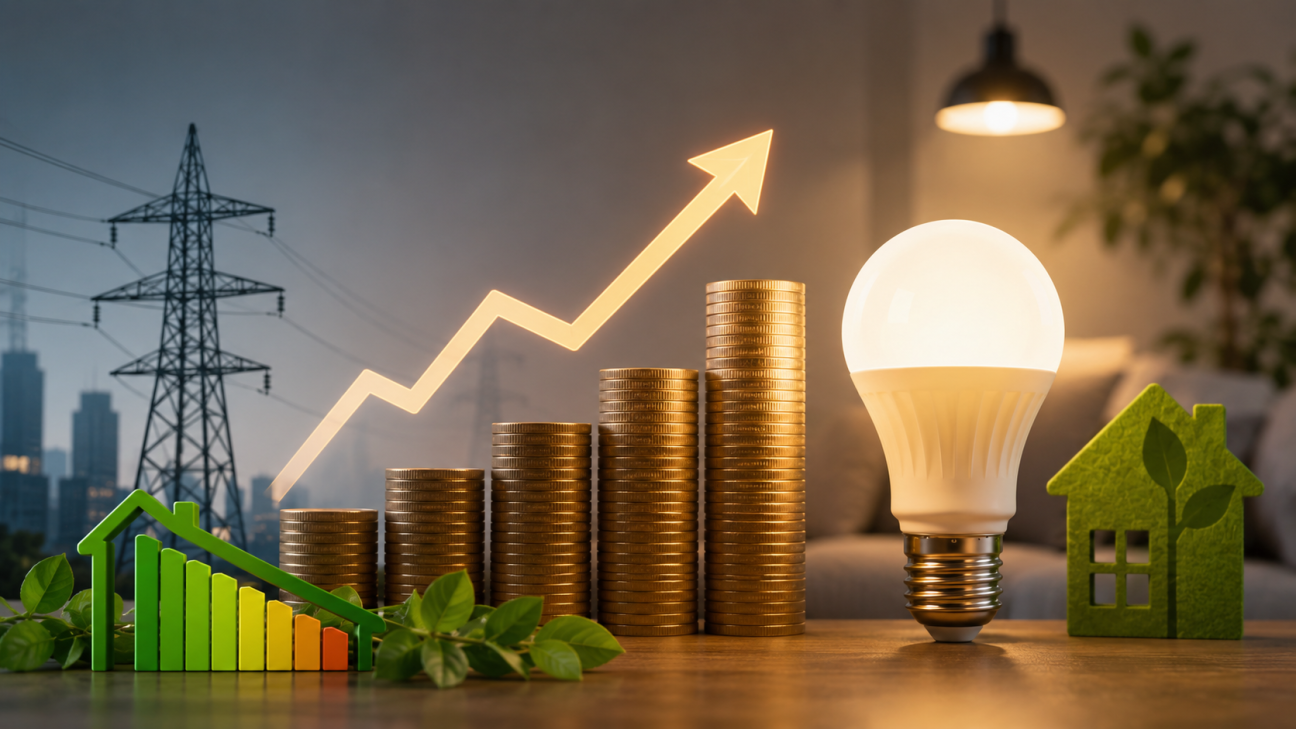
I never imagined that one of the biggest monthly discussions in my home would revolve around electricity consumption. Twenty years ago, when I had just started my career in software development in Chennai, lighting was something we rarely thought about. A bulb was just a bulb. We switched it on when needed and switched it off when leaving the room. Today, with rising electricity costs, growing environmental concerns, and increasing awareness around energy efficiency, lighting has become a serious conversation in middle-class Indian households like mine.
I am nearly 50 years old now, working in a MNC, and living with my wife, son, daughter, and elderly mother. Every room in our home has different lighting needs. My mother prefers soft warm lighting in the evenings because harsh white light strains her eyes. My daughter spends long hours studying and needs bright, focused illumination that keeps her alert without causing headaches. My son, like most teenagers, loves spending time gaming and watching content on screens, which means his room lighting needs to reduce eye fatigue. My wife wants the kitchen and utility spaces to be extremely bright and comfortable because she spends considerable time there every day. As for me, after spending decades staring at monitors in software development offices, I have become surprisingly sensitive to poor lighting quality.
Over the past few years, I began noticing how much attention consumers are paying to energy ratings in appliances. Earlier, people purchased televisions, refrigerators, air conditioners, and fans mainly based on brand name or appearance. Today, the first thing many buyers check is the BEE star label. The Bureau of Energy Efficiency, widely known as BEE, has transformed how Indian consumers think about electricity usage. Their awareness campaigns, rating systems, and continuous discussions around energy conservation have made ordinary citizens more conscious about the long-term impact of inefficient appliances.
Every few months, newspapers carry reports about BEE emphasizing energy savings, reducing national power demand, and promoting efficient technologies. Government officials repeatedly speak about the need to reduce wastage and adopt sustainable solutions. In cities like Chennai, where summers are becoming hotter every year and electricity demand rises sharply, energy-efficient products are no longer optional. They are becoming essential.
This growing awareness is exactly why lighting technology has evolved so rapidly. We moved from incandescent bulbs to CFLs and then to LEDs. Each stage brought substantial improvements in efficiency. However, a new category of lighting is now quietly changing the industry once again. These are what many experts are beginning to call “SuperBulbs.”
A SuperBulb is not just another LED bulb. The term is being used for LED lighting products that deliver extremely high energy efficiency, specifically above 150 lumens per watt. For ordinary consumers, this number may sound technical, but it is actually very important. Lumens measure brightness, while watts measure electricity consumption. When a bulb produces more lumens using fewer watts, it becomes significantly more efficient. In simple words, you get brighter lighting while consuming less electricity.
Most regular LED bulbs in Indian homes operate somewhere between 80 to 110 lumens per watt. Better-quality products may reach 120 or even 130 lumens per watt. But crossing the 150 lumens per watt mark requires serious engineering, high-quality components, superior thermal management, advanced drivers, and precision manufacturing. This is not something that every lighting company can achieve.
What fascinated me recently was learning that only one German lighting brand operating in India currently qualifies for this SuperBulb category. Their technology is pushing the boundaries of lighting efficiency in ways that were considered impossible a few years ago. As someone who has spent decades in the software industry, I have always appreciated engineering excellence. Whether it is software architecture or lighting technology, achieving performance improvements beyond industry standards requires obsession with detail.
When I first installed these high-efficiency lighting products at home, I honestly did not expect to notice much difference beyond lower electricity bills. But the experience was surprisingly different. The brightness quality felt more natural and evenly distributed. Heat generation was significantly lower. Rooms felt more comfortable even after several hours of usage. In Chennai’s climate, reducing unnecessary heat inside the house is a major advantage.
My mother immediately appreciated the softer visual comfort. My daughter noticed that she could study for longer durations without eye strain. My wife liked the brightness consistency in the kitchen, especially during cooking at night. As for me, I found that late-night work sessions became less tiring on the eyes. It may sound dramatic to say that lighting affects family wellbeing, but once you start paying attention, the impact becomes obvious.
One important factor that consumers often overlook is that energy efficiency is not only about saving money. It also affects national infrastructure. India’s electricity demand continues to rise rapidly. Every inefficient appliance contributes additional stress on the power grid. When millions of households adopt efficient lighting, the cumulative impact becomes enormous. Reduced power consumption lowers pressure on generation capacity, reduces transmission losses, and decreases dependence on fossil fuels.
This is exactly why organizations like BEE continue to emphasize efficiency improvements across industries. Their focus is no longer limited to industrial machinery or large commercial systems. Household-level consumption is equally important because small inefficiencies multiplied across millions of homes become national-level problems.
Interestingly, Indian consumers are becoming much smarter about these issues. Earlier, many people purchased low-cost LED products without checking specifications or quality standards. Today, buyers are reading labels carefully. They ask about wattage, lumens, lifespan, driver quality, warranty, and energy ratings. Social media, online reviews, and growing public awareness have made consumers far more informed than before.
I see this even in my office. Younger employees discuss inverter ratings, BLDC fan efficiency, and solar integration during lunch breaks. Ten years ago, such conversations were rare. Energy efficiency has become part of mainstream consumer thinking. People now understand that slightly higher upfront investment often leads to substantial long-term savings.
The rise of SuperBulbs represents the next stage in this evolution. Instead of simply replacing old lighting technologies, these products redefine what efficient lighting can achieve. They prove that technological advancement is still possible in categories many people consider mature or saturated.
As someone from the software world, I often compare this to processor development. Years ago, people believed computers had reached practical performance limits. Yet innovation continued through better architectures, optimization, and smarter engineering. Lighting technology appears to be following a similar path. The jump from standard LEDs to SuperBulbs may eventually become as significant as the earlier transition from CFLs to LEDs.
Another aspect I appreciate is the long-term economic logic behind efficient lighting. In a family of five like ours, lights remain switched on in different rooms almost continuously. My mother wakes up early, my children study late, and my work often stretches beyond regular office hours. Over time, even small efficiency improvements create meaningful reductions in electricity expenses. More importantly, efficient lighting products usually have better reliability and longer operational life, reducing replacement frequency.
For Indian households facing increasing electricity tariffs, this matters greatly. Every unit of power saved contributes directly to financial stability. At a national level, widespread adoption of efficient technologies can reduce energy imports and strengthen sustainability goals.
When I think about the future, I believe energy efficiency awareness will only increase further. Younger generations are already far more environmentally conscious than we were at their age. Schools discuss sustainability regularly. Companies include ESG goals in annual reports. Governments continue promoting efficient technologies. Consumers increasingly view energy efficiency as a mark of quality rather than merely a technical feature.
Lighting may appear like a small part of everyday life, but it quietly influences comfort, productivity, health, and national energy consumption. Technologies like SuperBulbs show that meaningful innovation is still happening in ordinary household products. And for families like mine in Chennai, where lighting remains essential from early morning until late night, choosing better efficiency is no longer just about saving electricity. It is about improving daily life in a practical, measurable way.