

How a Lighting Brand Rebuilt Its Digital Infrastructure Around AI, WordPress and Custom Commerce Engineering
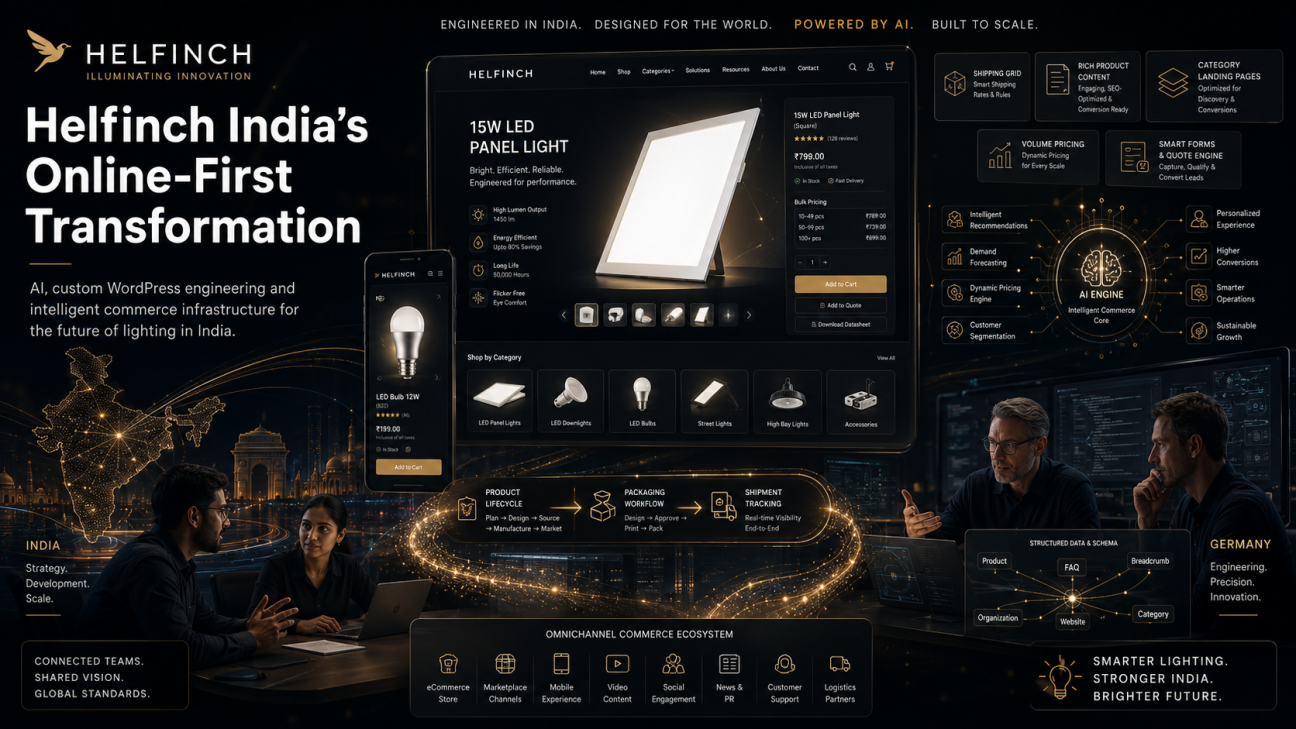
In India’s fast-expanding electrical and lighting market, the next serious battle is no longer being fought only on factory capacity, distributor depth or retail shelf visibility. It is being fought on digital infrastructure. For a modern lighting brand, a website is no longer a static catalogue, a corporate brochure or a contact form with product pictures attached to it. It is increasingly becoming the central operating layer through which product discovery, pricing, partner coordination, shipment logic, packaging visibility, warranty handling, structured search visibility and customer experience are connected. This is the context in which Helfinch India has undertaken one of its most ambitious technology projects so far: a six-month build of a highly customized, AI-assisted, online-first commerce platform based on WordPress and WooCommerce architecture, with custom-coded plugins, structured product intelligence and deep operational workflows designed specifically for the Indian lighting market. WordPress describes itself as open-source software for building websites, blogs and apps, and its flexibility is precisely why it remains attractive for companies that need more than a standard template-driven storefront.
The decision to build on WordPress was not accidental. In the hands of ordinary installers, a CMS can remain just a theme with some product pages. In the hands of experienced programmers, it becomes a programmable business platform. Helfinch’s view appears to be closer to the second interpretation. The company’s objective was to avoid the common trap of having a good-looking website that still depends on disconnected spreadsheets, manual courier calculations, inconsistent product descriptions, weak category pages and generic SEO plugins. Instead, the company brought in international web-development experience, including senior programming support from its German office, to build a system where the website could behave like an internal commerce engine. The project reportedly ran for more than six months, not as a cosmetic redesign but as a technical reconstruction of how product data, partner data, structured content and commercial logic could be handled inside a WordPress-based environment.
At the centre of this system is a series of proprietary plugins built for very specific Helfinch use cases. One of the most commercially important integrations is the shipping-cost grid built around the company’s 3PL partner, Eshopbox. Eshopbox positions itself as an ecommerce fulfilment platform providing warehousing, shipping, delivery and operational integrations for brands, which makes it a relevant logistics layer for an online-first D2C business. Instead of treating shipping as a flat-rate afterthought, Helfinch’s custom plugin is designed to read logistics cost structures and convert them into a usable shipping grid, enabling the commerce team to understand how fulfilment cost behaves across zones, weights, packaging types and order values. For a category like LED lighting, where products can range from small bulbs to panel lights, fans, street lights and commercial fixtures, such logic can directly influence margin protection and customer-facing pricing.
The second major technical layer is schema automation. Most ecommerce websites in India still treat structured data as a plugin checkbox, which often produces incomplete, duplicated or even contradictory JSON-LD markup. Helfinch has taken a more controlled approach by creating a schema system that reads the content already present on the site and generates structured data for products, breadcrumbs, organization information, website data, FAQs and category pages. This matters because modern search visibility depends not only on written content but on machine-readable clarity. A product page for a 15W LED panel light, for example, should not merely say that the product is efficient; it should expose product type, wattage, lumens, SKU, UPC or GTIN, colour temperature, warranty, dimensions, weight, application areas, availability and offer data in a consistent technical format. This is particularly important in India, where customers search across highly mixed buying intents: “15W panel light price,” “recessed LED panel light,” “cool white panel light,” “LED lights for false ceiling,” “bulk LED lights for office,” and “BEE rated lighting products.”
The third plugin family addresses product listing quality itself. Helfinch has built rich product content pages that behave closer to an Amazon-style A+ listing than to a default WooCommerce product description. The plugin standardizes technical details, features, benefits, application notes, FAQs and structured product fields into a consistent format. For a lighting brand, this is more than presentation. A bulb, panel light or inverter bulb is often judged by specifications that customers may not fully understand: lumens per watt, colour temperature, power factor, surge protection, rated life, base type, body material, voltage tolerance, beam spread and use case. A consistent rich-content engine allows Helfinch to explain these details in a format that is useful both to customers and to search engines. It also reduces the operational risk of every product page being written differently by different teams over time.
The fourth major plugin transforms category pages. Default WooCommerce category pages are typically weak: a title, a grid of products and perhaps a short description. Helfinch’s custom category landing-page system changes this by turning categories into content-rich commercial pages, closer in spirit to a brand page on Amazon India or a category showcase on large marketplaces. Amazon India highlights its marketplace role in enabling broad product selection and India-specific seller programs, while platforms like Flipkart continue to define how Indian consumers discover products online across electronics, appliances and home categories. For Helfinch, this kind of category depth is essential. A “Panel Lights” category page can now explain recessed versus surface installation, warm white versus cool white, wattage selection, false ceiling suitability, room applications, project supply and related FAQs. That is far more valuable than a bare grid of SKUs.
A fifth plugin layer deals with pricing. Volume pricing in the Indian lighting sector is not a luxury feature; it is a structural requirement. Retailers, electricians, housing projects, architects, contractors, government buyers and institutional customers do not all buy in the same pattern or at the same price logic. Helfinch has therefore built a volume-pricing system that can apply rules across products, categories and tags. The particularly interesting feature is that this system can be updated through a mobile-friendly internal organization app, with access rights assigned to the relevant teams. That means pricing does not remain trapped inside a developer workflow. Sales teams, channel teams and authorized internal users can adjust commercially approved pricing structures without breaking the technical architecture of the site.
Another operationally significant plugin handles interactive forms and lead routing. Rather than relying on one generic contact form, the website processes different enquiry types and routes them to the correct teams. Sales leads, brand association requests, government deals, architect sign-ups, retailer association enquiries, warranty claims and other business workflows can be separated at the point of entry. For a company trying to scale online, this is critical. A warranty claim should not land in the same inbox as an architect partnership request. A retailer association lead should not be treated like a consumer product enquiry. The stronger the form infrastructure, the cleaner the internal response system becomes.
The AI layer is perhaps the most forward-looking part of the Helfinch build. According to the company’s direction, the site includes a proprietary AI engine designed not only for customer experience but also for operational intelligence. It can support personalized product display, pricing suggestions based on user profile, and content customization even when a visitor is not logged in. In practical terms, a bulk buyer, a retailer, a consumer browsing from a metro city and a project buyer researching commercial lights may not need to see the website in exactly the same way. The AI system can help decide which products to highlight, what pricing logic to surface and what content to prioritize. Beyond the front end, the AI layer is also being connected to product lifecycle tracking, including shipment and packaging workflows, which suggests that Helfinch is thinking beyond conventional ecommerce and toward a more integrated digital operating model.
The company’s marketplace strategy reinforces that online-first position. Helfinch products are now available not only through its D2C platform but also on major Indian commerce channels including Amazon India, Flipkart, Blinkit, Instamart, JioMart and L&T-SuFin. Blinkit describes itself as a platform delivering thousands of products to the doorstep, Instamart is Swiggy’s grocery and convenience commerce channel, JioMart operates as Reliance Retail’s online shopping platform, and L&T-SuFin positions itself as an integrated B2B platform for industrial tools, construction materials, electricals and equipment. This combination is important because lighting demand in India does not come from one channel. A consumer may discover a bulb on a quick-commerce app, a contractor may buy through a B2B platform, a household may compare on Flipkart, and a project buyer may prefer direct engagement through helfinch.com.
The wider digital ecosystem also matters. Helfinch’s website is being connected with platforms such as YouTube, Instagram, Facebook, Google News and other social media channels, giving the brand a broader content-distribution model. For categories like LED bulbs, inverter bulbs, BLDC fans and LED panel lights, education is often as important as availability. Customers need to understand why 150 lumens per watt matters, how warm white differs from cool white, why panel lights are better for false ceilings, how inverter bulbs help during power cuts, and why 5-star rated lighting can matter for electricity bills. A modern D2C lighting brand cannot depend only on marketplace listings; it has to publish, explain, compare, demonstrate and guide.
Even the visual design of the website has been treated as part of the engineering conversation. Helfinch’s dark-background interface is not merely a branding choice. The company presents it as part of a lightweight, lower-energy digital design philosophy, using dark surfaces and optimized components to reduce energy consumption by up to 40 percent compared to a typical heavier website experience. That figure should be understood as a brand-side estimate based on its design and performance assumptions, but the strategic point is clear: the website is being positioned not only as a sales engine but as a digital expression of the company’s energy-efficiency philosophy. For a lighting brand built around efficient illumination, it is logical that the website itself should avoid digital excess.
The result is a technology stack that looks less like a standard WooCommerce implementation and more like a specialized commerce operating system for an Indian lighting company. It combines CMS flexibility, custom plugin engineering, AI-assisted personalization, structured data automation, rich product storytelling, logistics intelligence, volume pricing, partner workflows and marketplace integration. In a market where many brands still separate website, sales, logistics, SEO and product data into different disconnected systems, Helfinch is attempting to bring them into one controlled digital layer. That is the real significance of the project. The website is not only a place where products are displayed. It is becoming the place where the brand’s online-first future is being technically assembled.
For India’s LED lighting and electrical products market, this is a meaningful signal. The next generation of successful brands will not be defined only by manufacturing capability or distribution reach. They will also be defined by how intelligently they manage data, search visibility, customer segmentation, fulfilment logic and digital trust. Helfinch India’s new platform is an early indication of that shift: a lighting brand treating its website not as an accessory, but as infrastructure.