

The Agent-Native Enterprise Has Arrived: Helfinch, Andrea, and the German Blueprint for Autonomous Commerce
Helfinch is not positioning artificial intelligence as a chatbot, a content generator, or a back-office productivity add-on. It is building toward something structurally different: an agent-native operating model in which a digital AI agent, Andrea, becomes the coordination layer between brand, commerce, manufacturing intelligence, customer service, logistics, advertising, warranty, channel sales, and market feedback. This is not conventional automation. It is not a CMS plugin. It is not a marketing dashboard with AI copywriting attached. It is closer to an autonomous enterprise control plane, where software agents interpret business context, execute workflows, update digital assets, route operational decisions, and create a continuous learning loop between customers, products, retailers, internal teams, and external platforms.
At the center of this model is Andrea, an OpenClaw-based agent responsible for building, managing, and continuously upgrading the Helfinch digital ecosystem. In practical terms, Andrea designs campaign creatives, upgrades web pages, updates product content, optimizes pages according to current SEO logic, incorporates internal pricing memos into storefront execution, sends production requests based on D2C sales velocity, works with Meta Pixel signals to drive repeat-customer campaigns, handles customer service workflows, and generates internal recommendation notes from competitor analysis. This is what separates an agent-managed business from a digitally assisted business. A digitally assisted business uses AI to accelerate human tasks. An agent-managed business delegates full operational clusters to AI systems that can observe, reason, act, document, and improve.
The distinction matters. Andrea is not “AI on the website.” Andrea is an orchestration layer across the value chain. The website is only the visible interface. Behind it sits a more important architecture: product-level traceability, lifecycle data, pricing intelligence, customer behavior signals, logistics coordination, warranty registration, retailer outreach, campaign learning, and internal business memory. This is a move from static e-commerce to adaptive commerce. A product page is no longer a fixed document. It becomes a dynamic commercial object that can be rewritten, repositioned, repriced, and re-promoted as business conditions change. A customer-service interaction is no longer just a ticket. It becomes part of a product lifecycle graph. A sales objection from a retailer is no longer anecdotal. It becomes structured market intelligence.
Helfinch’s unit-level QR-code strategy is especially significant because it pushes the company beyond basic SKU management. Each product can be connected to a lifecycle database that tracks manufacturing, dispatch, sale, installation, registration, warranty, service, replacement, regional movement, and customer engagement. Once this data is available to an agent like Andrea, the product becomes machine-readable throughout its commercial life. The brand no longer has to depend only on monthly reports, retailer feedback, or customer complaints. It can build a live operational memory around every unit in circulation. That memory can support B2C fulfillment, B2B order servicing, logistics pickup scheduling, warranty validation, claim handling, regional demand analysis, and production planning.
This is not simple ERP automation. ERP systems record transactions. Agentic systems interpret them. A traditional workflow engine requires a predefined rule: if X happens, do Y. An agentic operating layer can evaluate broader context: sales velocity, campaign performance, product availability, warranty frequency, regional demand, retailer resistance, margin policy, competitor pricing, and internal management memos. It can then recommend, execute, or escalate. That is the architectural shift. The enterprise moves from deterministic process automation to probabilistic decision-support and semi-autonomous execution.
In marketing, this creates a new operating grammar. Andrea can design campaign creatives, assess product priorities, adapt landing pages, and use Meta Pixel-derived behavioral signals to support retargeting, repeat purchases, and segmented customer journeys. A user who engages with concealed downlights, premium ceiling fixtures, or warm-white home lighting can be moved into a more relevant communication sequence. Product interest can inform ad copy. Conversion data can inform page structure. Internal pricing goals can inform campaign hierarchy. Creative output, media learning, and website optimization no longer operate as separate departments. They become one closed-loop performance system.
In customer service, the same model compresses response time and improves precision. When a customer scans a QR code or submits a warranty request, Andrea can connect the request to the relevant unit, batch, purchase stage, registration status, logistics trail, and warranty policy. A claim does not begin as an isolated complaint; it begins with context. That matters because customer service in hardware categories often fails due to fragmented information. The buyer has one record, the retailer has another, the distributor has another, the service team has another, and the brand often sees the problem too late. An agentic lifecycle database reduces that fragmentation.
In sales, Helfinch’s use case becomes even more aggressive. Andrea is training 20 agents for online marketing and retailer outreach across India through phone calls, WhatsApp, and email. This is not merely lead generation. It is distributed market sensing. Each agent can capture retailer objections, stocking preferences, price sensitivity, regional product interest, competitor references, and channel friction. The output is not just more conversations. The output is structured commercial intelligence. A retailer in one state may want faster-moving economy SKUs. Another may demand premium display material. A third may resist pricing because a competitor has introduced a temporary discount. A human sales team may remember this informally. An agentic team can document it, classify it, compare it, and circulate action memos to internal stakeholders.
That is the operational breakthrough: sales conversations become data assets. WhatsApp replies become regional demand signals. Phone objections become pricing intelligence. Email responses become channel segmentation inputs. Competitor mentions become strategic watchlists. Retailer feedback becomes stocking policy. Once this information is consistently captured, Andrea can help produce action plans for pricing correction, regional assortment, product education, promotional bundles, stock allocation, and sales collateral.
This is what the future of commerce will look like for serious brands: autonomous digital operations connected to physical product intelligence and channel execution. It is not about replacing every human. That is the wrong frame. The better frame is compression. AI agents compress the distance between signal and action. They reduce the lag between a market event and a business response. They make internal knowledge executable. They turn product data into service workflows. They turn customer behavior into campaigns. They turn retailer feedback into management memos. They turn competitor activity into tactical recommendations.
The German relevance is not cosmetic. German brands have historically been built around engineering discipline, process reliability, quality assurance, lifecycle accountability, and industrial systems thinking. The agent-native enterprise extends these principles into software-defined commerce. Germany’s industrial philosophy has always valued traceability, standardization, precision, and feedback-controlled production. Agentic AI adds a cognitive layer to that tradition. It allows brands to manage not only machines and factories, but also websites, customer journeys, pricing decisions, campaign systems, retailer networks, service claims, and product intelligence through integrated digital operators.
This is why German brands are structurally well positioned in the next phase of AI-led business transformation. The winners will not be the companies that generate the most social media posts with AI. The winners will be the companies that integrate AI into quality systems, product databases, supply-chain logic, customer lifecycle management, channel execution, and governance. In that sense, the future is less about “AI creativity” and more about AI-controlled operational architecture. Creativity is one module. The real prize is enterprise cognition.
Helfinch’s Andrea model points to that architecture. It shows how a lighting brand can operate less like a conventional D2C company and more like a self-improving commercial system. Every product unit can become a data node. Every customer interaction can become a service signal. Every ad campaign can become a learning loop. Every retailer conversation can become a market-intelligence event. Every internal memo can become an executable instruction. Every warranty claim can become product feedback. Every competitor move can become a strategic note. This is a different kind of company: not merely digital-first, but agent-first.
It is important, however, to define what this is not. It is not blind autonomy. It is not a black-box system allowed to make uncontrolled business decisions. It is not a replacement for leadership, compliance, financial control, product accountability, or brand judgment. An agent like Andrea should not be treated as an ungoverned executive. The correct model is supervised autonomy: agents execute within permissions, policies, approval thresholds, audit logs, and business constraints. Pricing changes, customer commitments, warranty approvals, retailer terms, and production requests should be governed by authorization layers. The power of the system comes not from removing control, but from making control programmable.
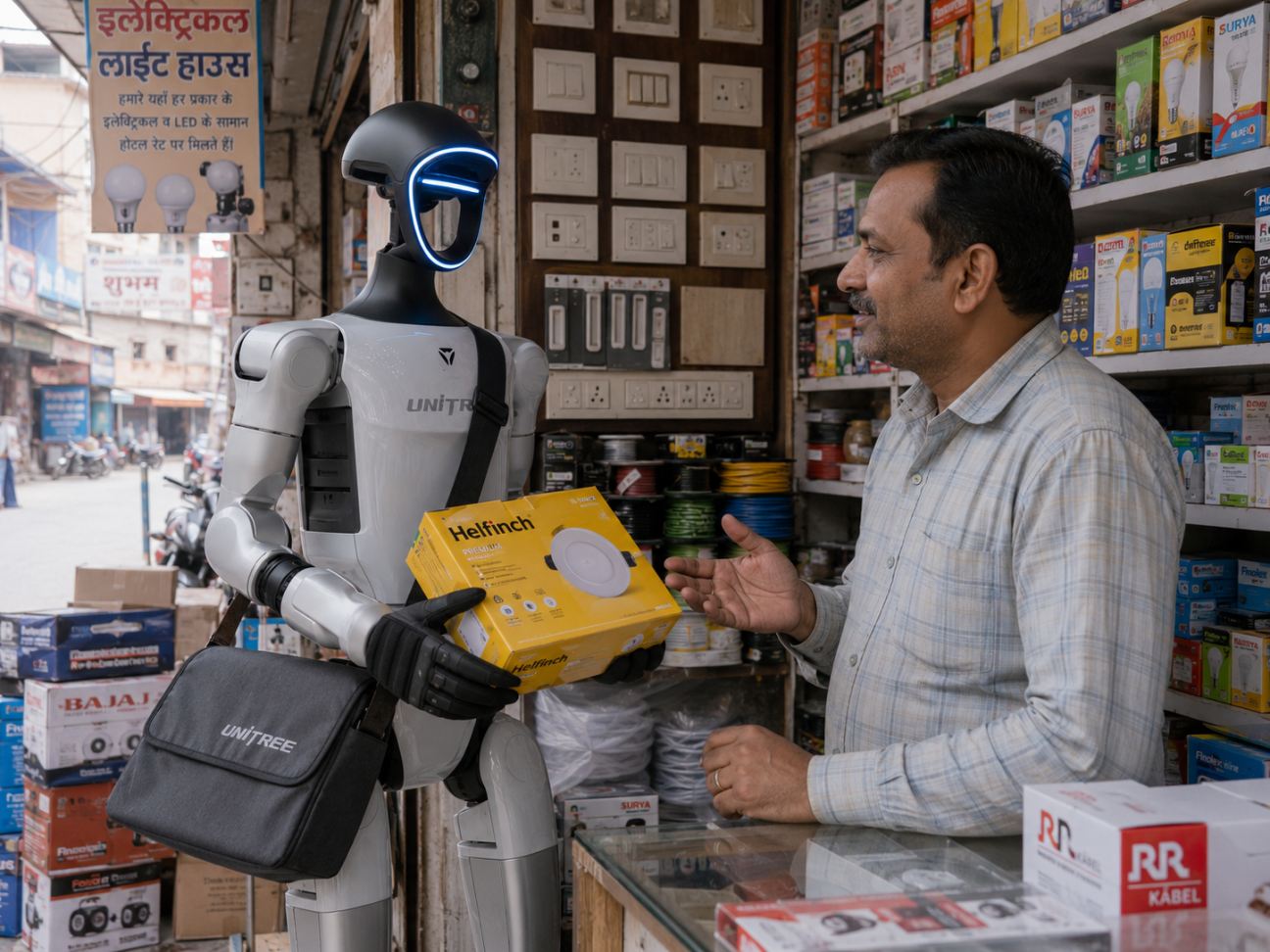
The next frontier is embodiment. Today, Andrea operates primarily in the digital layer: web management, SEO, creative production, customer service, Meta Pixel intelligence, QR-code lifecycle tracking, logistics coordination, warranty handling, retailer outreach, competitor analysis, and internal memo generation. In the coming phase, the learning accumulated by such agents can be transferred into physical robotic systems. Humanoid robots such as Unitree G1 indicate where the category is moving: mobile, interactive, sensor-rich, increasingly dexterous platforms capable of operating in physical environments. Once a business agent’s knowledge is connected to a robot body, digital intelligence becomes field presence.
For a brand like Helfinch, the implication is extraordinary. A future field-sales robot could visit retailers, speak in multiple Indian languages, scan shelves, identify stock gaps, demonstrate product features, explain installation use cases, compare product categories, collect retailer objections, document competitor pricing, answer warranty questions, and communicate with the organization in real time. It could interact with store owners, electricians, distributors, and sales managers while remaining connected to the same knowledge base Andrea uses digitally. If a retailer requests a pricing correction, the robot could log the issue, compare it against regional policy, escalate it to the right stakeholder, and return with an approved response. If a customer asks about installation, the robot could provide guided multilingual support. If a store display is incorrect, it could record evidence and recommend merchandising action.
This is not merely robotics. It is embodied enterprise AI. The robot is not valuable only because it walks or talks. It becomes valuable because it carries the company’s live commercial intelligence into the field. The body is the interface. The agent is the operating system. The database is the memory. The organization is the network. That combination creates a new class of business infrastructure: digital agents managing online operations, physical robots extending those agents into real-world environments, and human teams supervising strategy, governance, relationships, and exceptions.
The deeper transformation is cultural. Companies will need to stop treating AI as a side experiment and start designing around agentic workflows. Product databases must become cleaner. Internal memos must become machine-interpretable. Pricing logic must be structured. Warranty rules must be codified. Customer journeys must be measurable. Retailer feedback must be classified. Campaign data must be connected. Logistics systems must be accessible. Governance must be explicit. Poorly organized companies will not benefit fully from agents because agents amplify structure. If the business is chaotic, the agent inherits chaos. If the business is disciplined, the agent compounds discipline.
That is why the German model matters again. German industrial thinking is not only about machines; it is about systems that can be trusted. In an agentic economy, trust will be built through data integrity, process governance, lifecycle traceability, auditability, and controlled autonomy. The brands that combine these principles with AI agents will be able to scale faster without losing operational coherence.
Helfinch’s Andrea-led operating model is therefore more than a technology story. It is a preview of the agent-managed enterprise: a company where websites update themselves, campaigns learn continuously, products report their lifecycle, customers receive contextual service, retailers become data channels, internal memos become workflows, and future robots carry organizational intelligence into the field. This is the next race in global business technology. Not AI as a feature. Not AI as a department. AI as the operating layer of the company itself.