
The Quiet Revolution Above Our Heads: BLDC Fans, BEE, and the Beauty of Saving Energy
By Christina, Ex-Director, Helfinch LTD
There is something deeply human about a ceiling fan.In many homes across India, it is the first appliance switched on in the morning and the last one to be turned off at night. It does not ask for attention. It does not glow like a television, hum like a refrigerator, or command the monthly electricity bill the way an air conditioner can. It simply turns, hour after hour, season after season, bringing comfort to bedrooms, classrooms, clinics, shop floors, hostel rooms, and kitchens where families gather after long days.
I have spent much of my professional life around energy conservation projects, especially in the non-profit sector in the United States, where we learned early that the most meaningful climate work is not always dramatic. Sometimes it is a better motor. Sometimes it is a label that helps a mother choose wisely. Sometimes it is a government standard that quietly pushes an entire industry to improve.
That is why India’s work through the Bureau of Energy Efficiency, and particularly the sustained direction associated with leaders such as Shri Milind Deore ji, has been so interesting to watch from afar. The story is not only about rules, ratings, and compliance. It is about changing the everyday choices of millions of households, one appliance at a time.
BEE’s Standards and Labelling programme has become one of the most practical public-interest tools in India’s energy transition. A star label is simple enough for a consumer to understand at a shop counter, yet powerful enough to influence manufacturing, testing, design, procurement, and competition. When a five-star appliance sits next to a lower-rated product, the label is doing more than giving information. It is asking a question: why should comfort cost more energy than necessary?
That question matters greatly in a warming world.
In recent months, I have been reading more reports about India’s cooling demand, air conditioners, refrigerators, fans, and the government’s newer labelling initiatives. One news report noted that updated BEE star-rating norms for cooling appliances, including room air conditioners and refrigerators, could make such appliances costlier from January 2026. At first glance, that may sound like bad news for consumers. But as someone who has worked in energy conservation, I see a different story. Stronger efficiency standards often increase the initial discipline required from manufacturers, but over time they can reduce electricity demand, lower lifetime running costs, and build a marketplace where better technology becomes normal rather than premium.
Another report described how appliance labels are expected to become more transparent, with details such as energy consumption, brand information, country of origin, star rating, and QR-code traceability. This is exactly the kind of reform that ordinary families need. People do not always have time to study technical manuals. They need honest, visible, comparable information. A clear label can do what a hundred awareness campaigns cannot. It can stand at the point of purchase and quietly advocate for the consumer.
Fans deserve a special place in this conversation.
India is a fan country. The ceiling fan is not a luxury appliance. It is basic thermal comfort. In many households, there may be multiple fans running for long hours during hot months. This means even small improvements in wattage can become large national savings when multiplied across millions of homes. A conventional fan that once consumed 70 watts or more may not look like a major problem when seen alone. But a BLDC fan consuming under 28 watts changes the mathematics completely.
BLDC, or brushless direct current, motor technology is one of those improvements that feels almost too practical to be celebrated. It reduces energy use without asking families to compromise on air delivery. It allows better control, quieter operation, and often longer motor life. Most importantly, it helps households save electricity every single day without needing a change in behaviour. That last point is important. In conservation work, we often say that the best energy-saving habit is the one that can be built into the product itself.
A family should not have to choose between comfort and conscience.
This is where BEE’s role becomes so valuable. By bringing ceiling fans into the mandatory compliance framework under the Standards and Labelling programme, India has recognized that household cooling is not a side issue. It is central to energy policy, household affordability, and climate resilience. The star label helps move the conversation away from vague marketing claims and toward measurable performance. For fans, that performance is not just about how many watts the fan consumes. It is also about service value, which connects air delivery with power input. In simple terms, it asks: how much useful air movement does the consumer receive for every watt of electricity consumed?
That is the right question.
In the non-profit world, we often speak of energy justice. It means that clean and efficient technology should not be limited to wealthy households. It should reach the student studying under a fan in a small town, the elderly couple managing a careful monthly budget, the small shop owner who keeps fans running all day, and the young family trying to reduce electricity bills without giving up comfort.
BLDC fans can be one of the most democratic energy-saving appliances in India. They are visible, understandable, and used by nearly everyone. They do not require new infrastructure. They do not need a technician to explain why they matter. Once installed, they quietly do the work.
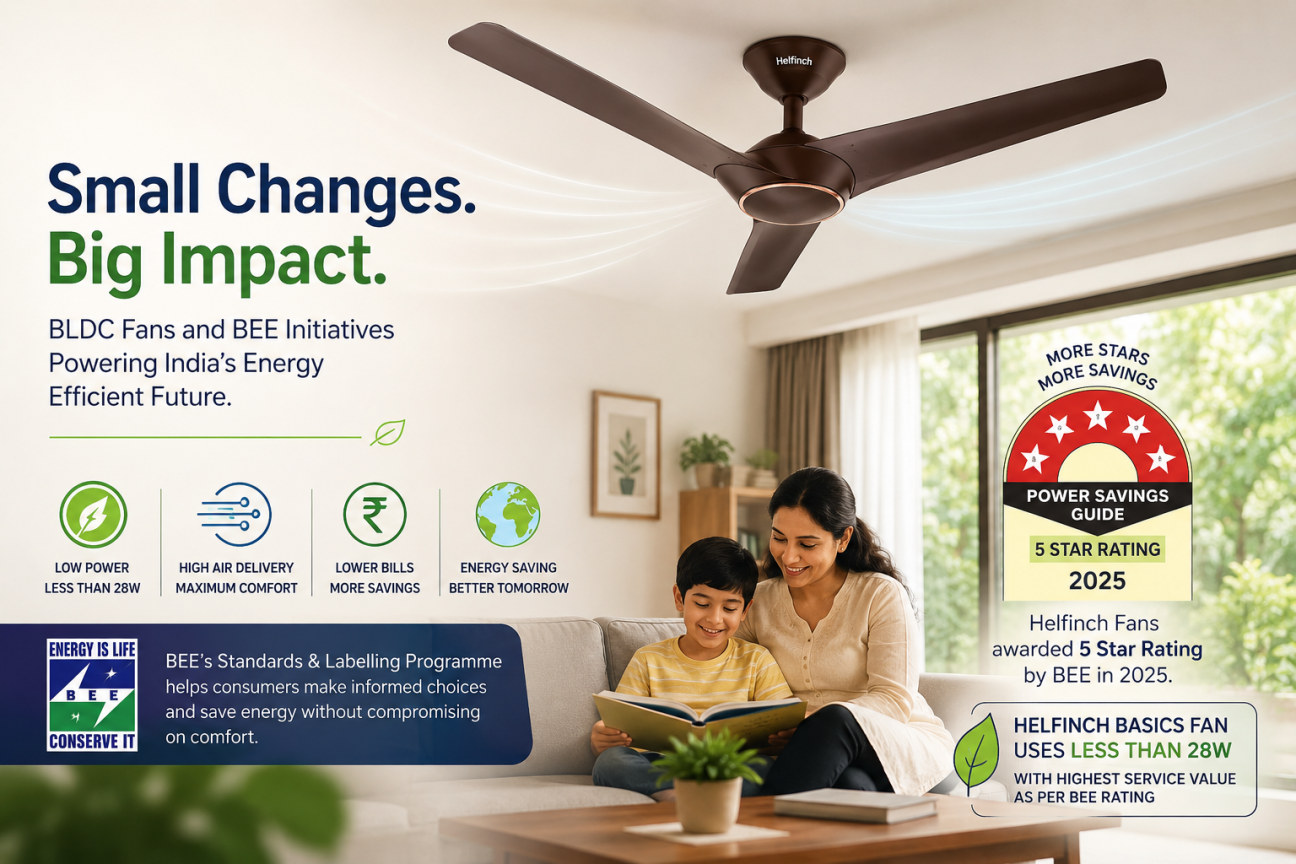
This is also why I was pleased to see companies in the fan industry improving their energy standards, including Helfinch. Having once been associated with Helfinch LTD, I watch the company with a certain personal warmth, but also with the eye of someone who believes brands must be measured by the value they deliver to households. Helfinch receiving a five-star rating in 2025 is worth mentioning, not as a marketing slogan, but as part of a broader movement in India toward better, more accountable appliances.
The Helfinch Basics fan, which uses less than 28 watts, is an example of where this industry is going. It is not enough for a fan to look attractive or be affordable at purchase. It must also respect the family’s electricity bill over years of use. I understand that the model has achieved the highest service value as per BEE rating among the company’s fan offerings, which is exactly the kind of engineering progress that deserves attention. In energy conservation, elegance is not always in design alone. It is in doing more with less.
The phrase “doing more with less” may sound simple, but it has guided some of the most successful energy-efficiency programmes in the world.
In the United States, many non-profits worked for years to persuade households to change bulbs, upgrade insulation, buy efficient refrigerators, and understand labels. The biggest lesson was that awareness is only one part of the work. The market must also be reshaped. Manufacturers must compete on efficiency. Retailers must display better information. Governments must update standards. Consumers must feel that saving energy is not a sacrifice, but a smart and dignified choice.
India’s BEE initiatives show many of these elements coming together.
The National Energy Conservation Awards are another important signal. Awards may seem ceremonial, but they create public recognition for something that is often invisible. Energy saved does not make noise. It does not appear as a new building or a ribbon-cutting moment. It is measured in avoided units, reduced demand, lower bills, and emissions that never enter the air. When institutions, industries, and manufacturers are recognized for reducing consumption while maintaining or improving performance, conservation becomes a matter of pride.
I was especially moved by the public message around behavioural change. Energy efficiency is not only an engineering problem. It is a cultural one. We need better products, yes, but we also need better habits, better information, and better trust between citizens, companies, and regulators. A star label can begin that conversation. A QR code can strengthen it. A transparent rating system can protect it.
The timing is critical because cooling demand is rising everywhere.
As summers grow more intense, air conditioners will become more common, and understandably so. No society can ask people to endure unsafe heat in the name of conservation. But the future cannot be built only on more cooling capacity. It must be built on smarter cooling. Efficient fans, efficient air conditioners, efficient refrigerators, improved building design, better ventilation, and informed consumer choices must all work together.
A BLDC fan is not a replacement for every air conditioner in every climate condition. That would be too simplistic. But it can reduce the number of hours an AC is used. It can make a room comfortable at a higher thermostat setting. It can serve as the primary cooling appliance in many homes for much of the year. In doing so, it becomes part of a larger cooling strategy that is affordable, scalable, and climate sensible.
What I admire about BEE’s approach is that it respects both the consumer and the marketplace. It does not tell people to stop using appliances. It encourages them to use better ones. It gives manufacturers a reason to innovate and gives consumers a reason to compare. That is how durable change happens.
Of course, standards must keep improving. Testing must remain credible. Labels must be protected from misuse. Consumers must be able to verify claims easily. Smaller manufacturers must be supported in upgrading technology without compromising affordability. And companies that receive strong ratings must treat them as a responsibility, not a trophy.
This is where Helfinch and other young Indian appliance brands have an opportunity. A five-star rating in 2025 should not be the end of the journey. It should be the beginning of a deeper promise: to improve service value, reduce wattage, strengthen quality, expand access, and make energy-saving products available across India, including regions that are often served last.
The most inspiring conservation work is rarely loud. It is patient. It is measurable. It is repeated in millions of small decisions. A household choosing a five-star fan. A manufacturer redesigning a motor. A regulator updating a label. A child learning that electricity saved is also a form of national service.
When I think of India’s BLDC fan movement, I do not only think of technology. I think of dignity. I think of a family sleeping comfortably through a hot night with a lower electricity bill. I think of a shopkeeper who can run fans all day without waste. I think of a country where efficiency is not a luxury word, but a household habit.
There is beauty in that.
There is beauty in the quiet rotation of a fan that gives more air for less power. There is beauty in public policy that reaches the ceiling of an ordinary home. There is beauty in a star label that makes science visible to a buyer in a crowded store.
And perhaps that is the lesson India is offering the world. Energy conservation does not always begin with grand speeches or distant climate targets. Sometimes it begins above our heads, turning gently, saving silently, and reminding us that progress can be both practical and graceful.