

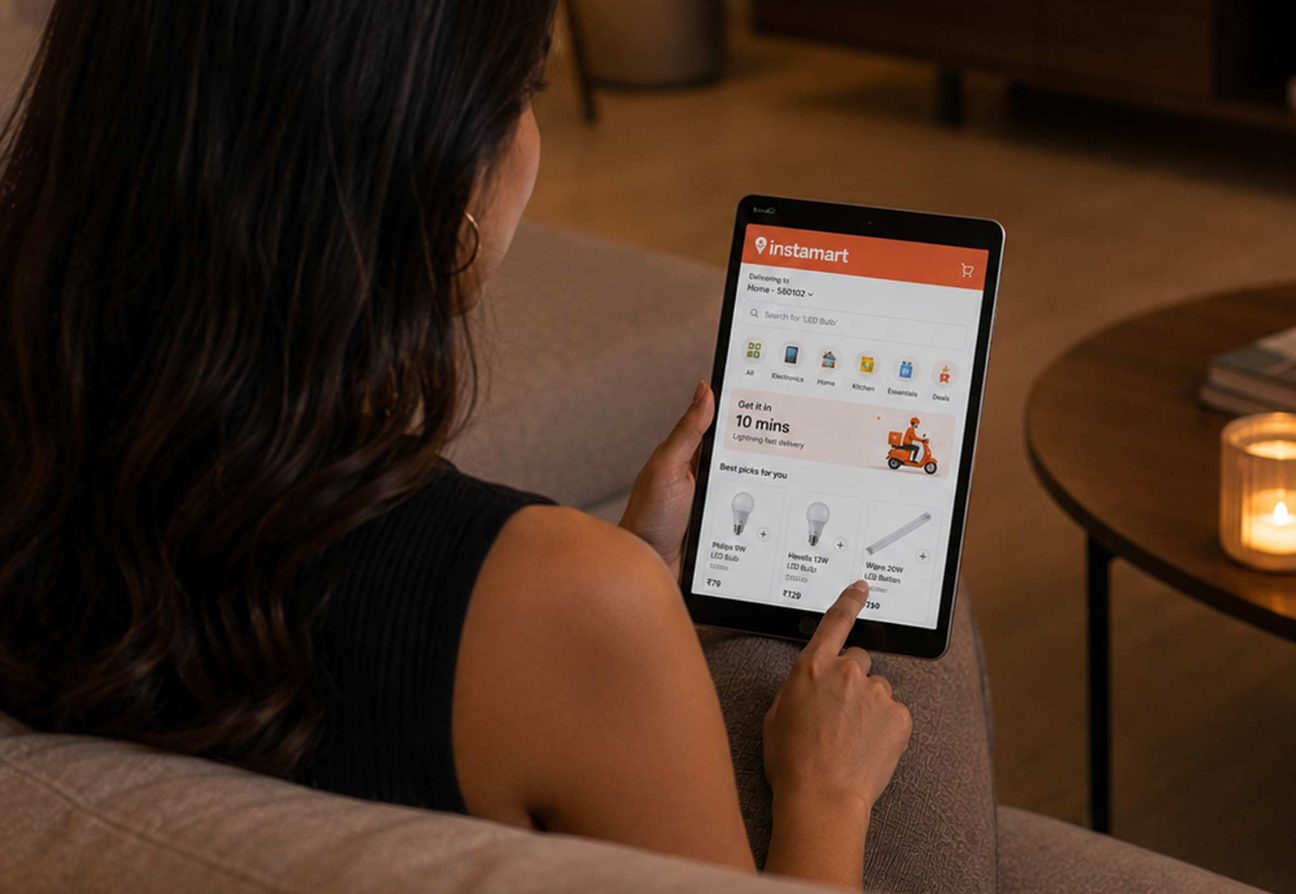
India’s quick commerce revolution is rapidly transforming the way consumers shop, and what initially began as an ultra-fast grocery delivery model is now evolving into a much larger retail ecosystem that includes categories far beyond food and household staples. Over the past two years, platforms such as Blinkit, Zepto, Swiggy Instamart, and JioMart have fundamentally changed consumer expectations around convenience, speed, and instant product availability. Today, customers no longer associate fast delivery only with groceries. Increasingly, they expect immediate access to daily-use essentials across multiple categories, including electrical products.
This shift is quietly creating one of the most important emerging opportunities in India’s electrical retail market. Products like LED bulbs, extension boards, smart lighting accessories, chargers, emergency lamps, and compact electrical items are beginning to find a natural place within the quick commerce ecosystem. The reason is simple: many electrical products are no longer considered occasional purchases. They are now viewed as immediate-need essentials.
A failed LED bulb late at night, a damaged charging adapter during work hours, or the sudden need for an emergency light during a power outage are all situations where consumers increasingly prefer instant delivery over waiting several days for traditional ecommerce fulfillment. This behavioral shift aligns perfectly with the core promise of quick commerce — convenience delivered within minutes.
The rise of urban digital lifestyles in India has accelerated this transition even further. Consumers in metropolitan cities have become deeply accustomed to app-based purchasing habits, where mobile phones serve as the primary shopping interface for everything from groceries and medicines to electronics and household utilities. As a result, the distinction between planned shopping and urgent shopping is gradually disappearing. Consumers are becoming more comfortable ordering products the moment they need them, rather than maintaining inventory at home.
Electrical products fit this model exceptionally well because many of them are lightweight, compact, affordable, and easy to stock within the dark-store infrastructure used by quick commerce platforms. Unlike large appliances that require complex logistics and installation support, products such as LED bulbs and compact lighting solutions can be delivered quickly and efficiently through hyperlocal fulfillment systems.
Among all electrical categories, LED lighting is expected to emerge as one of the strongest segments within quick commerce. The Indian lighting market has already undergone a major transformation over the last decade with widespread adoption of energy-efficient LED technology. Consumers are now highly familiar with LED products and understand their benefits in terms of electricity savings, lower maintenance costs, and longer operational life. Because lighting products are universal household necessities, demand remains consistent across urban and semi-urban markets.
The nature of LED products also makes them highly suitable for app-based shopping behavior. Consumers usually do not require lengthy research before purchasing a standard LED bulb or basic lighting accessory. Purchasing decisions are often quick and convenience-driven, particularly when replacing failed products. This creates ideal conditions for instant delivery platforms.
At the same time, quick commerce companies themselves are aggressively expanding into higher-margin categories beyond groceries in order to improve profitability and increase average order values. Electrical products represent an attractive opportunity because they combine relatively stable demand with better margins compared to many grocery items. As these platforms continue optimizing their inventory systems and expanding warehouse assortments, electrical products are expected to occupy increasingly prominent positions within app catalogs.
The competitive landscape is also becoming far more dynamic as large ecommerce companies rapidly adapt to changing consumer expectations. While Blinkit and Zepto pioneered the ultra-fast delivery model, Amazon and Flipkart are investing heavily in hyperlocal fulfillment, same-day delivery networks, and regional warehousing systems in order to close the convenience gap. Both companies already possess massive seller ecosystems, sophisticated logistics capabilities, and broad electrical product catalogs, giving them a strong foundation to compete aggressively in fast-delivery commerce.
This convergence between traditional ecommerce and quick commerce is likely to redefine online retail in India over the next few years. Consumers may eventually stop distinguishing between “ecommerce” and “quick commerce” altogether. Instead, fast fulfillment could simply become the default expectation across all retail categories.
For electrical brands and manufacturers, this transition creates both opportunities and challenges. Product visibility within app-based ecosystems is becoming increasingly important, particularly as consumer purchasing decisions shift toward search-driven and recommendation-driven interfaces. In the quick commerce environment, factors such as packaging clarity, product images, ratings, brand familiarity, and instant availability can heavily influence purchasing behavior.
This means electrical companies will increasingly need to optimize products not only for physical retail shelves but also for digital storefronts viewed on mobile devices. The future of electrical retail may depend as much on digital discoverability and hyperlocal availability as on traditional distributor relationships.
Consumer expectations are also evolving rapidly. Modern buyers increasingly prioritize convenience over store loyalty. Instead of traveling to a physical electrical shop for a replacement bulb or lighting accessory, many urban consumers now prefer the simplicity of placing an app-based order that arrives within minutes. This behavioral shift is particularly strong among younger consumers, working professionals, and digitally native households.
India’s broader economic and infrastructure trends further support the growth of electrical products within quick commerce. Rapid urbanization, rising smartphone penetration, smart home adoption, and increasing awareness around energy efficiency are all contributing to higher demand for modern lighting and electrical accessories. As homes become more connected and consumers become more digitally engaged, the frequency of small electrical purchases is likely to increase.
Additionally, the push toward energy-efficient living is expected to play an important role in shaping future demand patterns. LED bulbs, smart lighting products, and compact energy-saving electrical solutions align naturally with modern urban lifestyles focused on efficiency, sustainability, and lower electricity costs. Quick commerce platforms are uniquely positioned to accelerate the adoption of these products by making them instantly accessible.
For manufacturers focused on energy-efficient product ecosystems, this evolving retail landscape presents significant long-term potential. Companies that can combine reliable manufacturing, strong branding, digital-first visibility, and scalable distribution capabilities may gain substantial advantages as quick commerce continues expanding across India.
Helfinch’s focus on high-efficiency lighting solutions, scalable manufacturing infrastructure, and modern electrical products aligns closely with these emerging market trends. As consumer behavior increasingly shifts toward instant-access retail ecosystems, reliable and energy-efficient electrical products are expected to become a major part of India’s next-generation commerce infrastructure.
The transformation currently underway in India’s retail sector is not simply about faster delivery. It represents a larger shift in how consumers think about purchasing everyday products. Electrical items that were once purchased occasionally through local retail channels are steadily becoming part of an on-demand convenience economy driven by speed, accessibility, and digital-first behavior.
Over the next several years, electrical products are likely to become one of the fastest-growing categories within India’s quick commerce market. Platforms such as Blinkit, Zepto, Instamart, JioMart, Amazon, and Flipkart are all racing to capture this opportunity as the boundaries between ecommerce, convenience retail, and instant delivery continue to disappear.
The future of electrical shopping in India will not only be online — it will be immediate.