

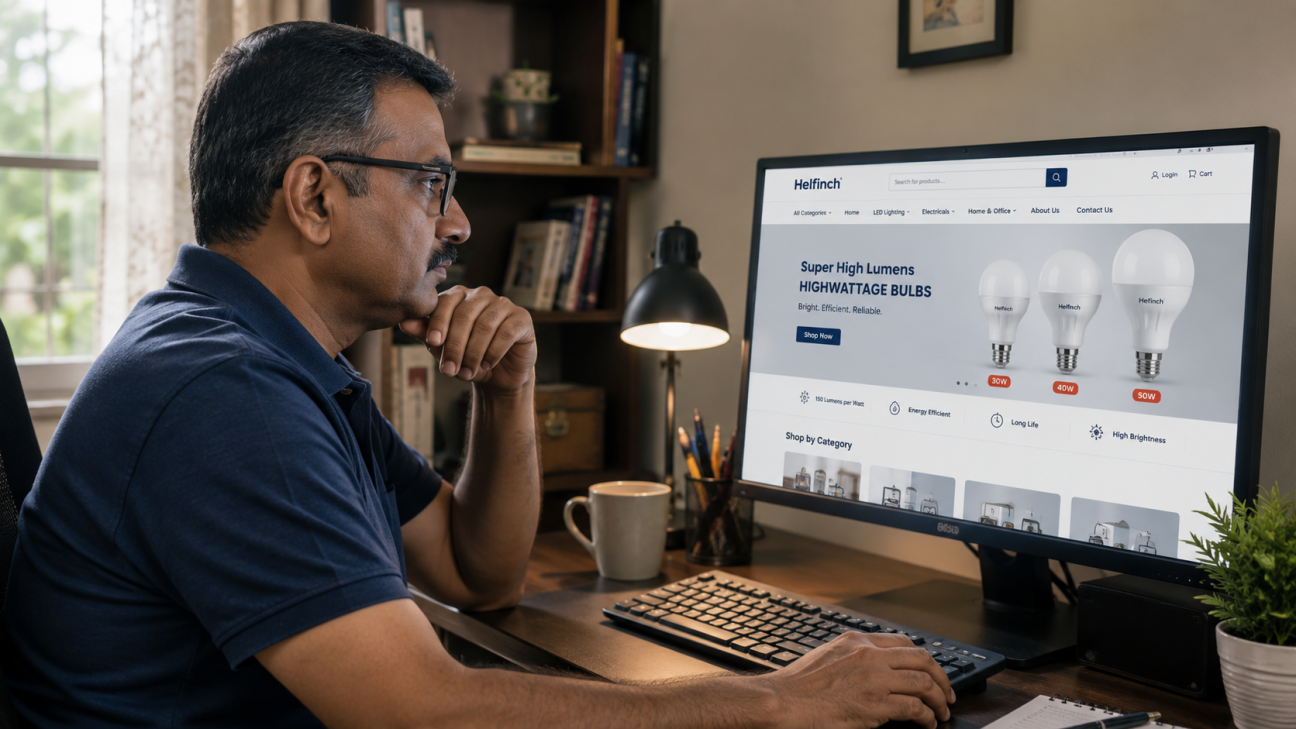
Did you know whats happening with Indian consumers over the last few years, and I don’t think enough people are talking about it seriously. Running an online business no longer feels like some complicated startup fantasy reserved for tech founders sitting in Bengaluru cafés discussing venture capital. It has quietly become something ordinary people are doing from their homes, warehouses, spare rooms, and sometimes even from their phones during lunch breaks at their regular jobs. I’ve been noticing this shift everywhere lately, especially in categories people usually consider boring at first glance, like electrical goods, LED bulbs, switches, panel lights, and home utility products. And honestly, after spending some time understanding how this entire ecosystem works now, I genuinely feel this might be one of the best periods in recent memory to enter the online electrical products business in India.
The biggest reason is simple: Indian consumers have completely changed. Five or six years ago, people still hesitated before ordering something online unless it was clothing or mobile phones. Today that hesitation barely exists anymore. People order groceries online, medicines online, furniture online, and increasingly even technical products like lighting, wiring accessories, fans, appliances, and power backup equipment online without thinking twice. The pandemic accelerated this shift massively. Even people who once distrusted digital payments or worried about product authenticity eventually became comfortable with apps, online returns, and doorstep delivery. Once people experience convenience at that scale, they rarely go backward.
I saw this change happen gradually in my own family. Earlier, buying electrical goods meant visiting local hardware stores, comparing products physically, asking the shopkeeper endless questions, and then carrying everything home yourself. Now people sit on their sofa at night, compare specifications across different brands, read reviews, check lumen output, wattage, warranties, delivery timelines, and place the order within minutes. The entire buying process has become smarter and more informed. Consumers are no longer blindly choosing the cheapest bulb available. They’re beginning to understand concepts like efficiency, power consumption, brightness quality, and product durability.
That is exactly why LED lighting has become such an interesting category. Unlike trendy gadgets or seasonal products that lose relevance quickly, lighting is permanent. Every home needs it. Every office needs it. Every warehouse, classroom, shop, clinic, apartment, and commercial space depends on it daily. Bulbs fuse eventually, tube lights age, people renovate homes, shops expand, builders launch new projects, and suddenly demand keeps regenerating endlessly. There’s something very stable about this business because you’re not trying to convince customers to buy unnecessary luxury products. You’re solving a basic requirement people will always have.
And the fascinating part is how rapidly LED technology itself is evolving. A few years ago, most people only cared whether a bulb switched on properly. Now consumers compare efficiency ratings, color temperatures, beam spread, and lumen output. High-efficiency products delivering 150 lumens per watt are becoming discussion points even among regular buyers. Electricity bills are rising constantly across India, and households are becoming far more conscious about power consumption. The average buyer now understands that paying slightly more upfront for an efficient LED can save meaningful money over time. That awareness creates tremendous opportunities for brands and sellers focused on quality rather than simply chasing low pricing.
What surprised me while researching this industry was how accessible online selling has become. Earlier, starting an e-commerce business required significant technical knowledge, warehouse management, logistics partnerships, and payment infrastructure. Today platforms like Amazon and Flipkart have simplified the process so dramatically that even first-time entrepreneurs can begin relatively small and still scale steadily. The onboarding process itself is no longer intimidating. You create listings, upload product details, manage stock, and the marketplace infrastructure handles most of the difficult backend work.
Of course, selling online still requires discipline. Product quality matters immensely because customer reviews now influence buying decisions heavily. Poor packaging, misleading specifications, or unreliable products get exposed quickly. But for sellers genuinely offering good products, the reach these platforms provide is extraordinary. Millions of active buyers already trust these marketplaces. That trust transfers partially to your products when you sell through them properly.
The logistics side is where things become especially interesting now. One of the biggest operational headaches earlier was inventory management across multiple platforms. Imagine trying to sell the same LED bulbs simultaneously on Amazon, Flipkart, your own website, and maybe other B2B marketplaces. Managing stock manually becomes chaotic very quickly. Overselling happens, inventory mismatches happen, deliveries get delayed, and suddenly a side business starts consuming your entire life.
This is where fulfillment partners and modern 3PL systems changed everything. Companies like Eshopbox created infrastructure that allows sellers to centralize operations instead of managing separate inventories for every marketplace individually. You store products in one professional fulfillment network, connect your online sales channels, and orders get processed automatically from a unified inventory pool. That sounds simple on paper, but operationally it changes the entire business model.
Earlier, scaling meant increasing complexity almost exponentially. More orders meant more staff, more warehouses, more confusion, and more operational risk. Today you can scale product categories and order volumes while keeping operations relatively lean. Someone with a small but carefully selected product catalog can compete nationally without owning massive infrastructure themselves. That democratization is probably one of the most underrated business shifts happening in India right now.
Another thing people underestimate is the advantage of electrical goods having relatively predictable demand cycles. Fashion trends change constantly. Consumer electronics become outdated rapidly. But lighting products move differently. Demand remains stable throughout the year with additional spikes during renovation seasons and festivals like Diwali, Durga Puja, Christmas, and New Year when homes and commercial spaces undergo upgrades. This predictability helps inventory planning significantly.
And unlike perishable categories, LED products generally have good shelf life when sourced properly. Sellers don’t face the same urgency or wastage risks associated with food products, cosmetics, or seasonal inventory. That stability matters enormously for small entrepreneurs starting cautiously.
The Indian government’s continued push toward digitization, MSME support, and manufacturing growth also created favorable conditions indirectly supporting online business expansion. GST compliance systems are smoother than they were initially. Digital payments have become mainstream even in smaller cities. Courier networks now reach towns that were once difficult to service efficiently. Internet penetration keeps increasing. Combined together, these developments quietly built an environment where online commerce feels less like an experiment and more like standard business practice.
One thing I personally find exciting is how educated the customer base is becoming in lighting specifically. Buyers now ask smarter questions. They compare lumen efficiency instead of only wattage. They understand that brightness quality matters more than just power consumption numbers. They check warranties carefully. This evolution benefits sellers who genuinely invest in better products because quality becomes easier to communicate online through detailed descriptions, specification charts, videos, and reviews.
And that educational aspect is powerful. A good online seller today isn’t just shipping boxes. They’re helping customers understand why one product performs better than another. Explaining concepts like energy savings, driver efficiency, surge protection, lifespan ratings, and lumen-per-watt performance builds trust. Once customers trust your recommendations, repeat business follows naturally.
What also makes this business attractive is flexibility. Many people begin as side entrepreneurs while continuing their primary jobs. They test product categories gradually, learn marketplace systems slowly, understand customer behavior, and reinvest profits carefully. Because operational tools are now more streamlined, you no longer need massive teams immediately. A motivated individual with decent supplier relationships and consistent attention to quality can realistically build something meaningful over time.
Competition is definitely increasing, but strangely that’s not necessarily a bad sign. Growing competition usually indicates expanding demand. More sellers entering the market means more customer awareness, stronger ecosystems, better logistics infrastructure, and faster category growth overall. The real challenge isn’t merely entering the market anymore. It’s building reliability and differentiation within it.
I’ve noticed that successful sellers in electrical categories often focus on consistency rather than shortcuts. Good packaging, honest specifications, timely deliveries, responsive support, and reliable quality matter more than flashy advertising in the long run. Electrical products enter people’s homes and workplaces. Once trust is broken in this category, recovering customer confidence becomes difficult. But the reverse is also true. Once customers trust a brand or seller for lighting products, they tend to return repeatedly for future purchases.
Sometimes people overcomplicate entrepreneurship by imagining it must involve revolutionary ideas or enormous funding. But many successful businesses are built around essential products executed extremely well. Lighting falls perfectly into that category. Every city is growing, every building requires illumination, every business depends on electricity, and every consumer increasingly values efficiency.
That’s why I genuinely believe this moment feels different for online electrical commerce in India. The infrastructure is ready. Consumer behavior has shifted permanently. Logistics networks are mature enough to support national-scale distribution. Marketplaces simplified entry barriers. Technology reduced operational friction. And customers are actively seeking better, smarter, more efficient products.
For someone willing to learn patiently, source quality products, and treat customer trust seriously, this industry offers something rare today: a combination of scalability, recurring demand, and practical accessibility. Not many business categories manage to combine all three this effectively anymore.